

When choosing an insurance plan, your deductible is a key factor that directly affects your monthly premiums and out-of-pocket costs during a claim. A deductible is the amount you pay upfront before your insurance covers the rest. Here’s the main takeaway:
- Lower deductibles mean higher premiums but less out-of-pocket expense during a claim.
- Higher deductibles reduce premiums but require you to cover more in case of a loss.
For example, raising your deductible from $500 to $1,000 can save you $323 annually, but you’ll need to be prepared to pay more upfront in an emergency. Nearly half of Americans struggle to cover a $400 expense, so balancing your deductible with your financial situation is crucial. Evaluate your savings, risk tolerance, and the likelihood of filing a claim to find the best fit for your budget and needs.
What Is an Insurance Deductible and How to Choose the Right One for You?
sbb-itb-20dac12
How Deductibles Affect Your Insurance Premiums
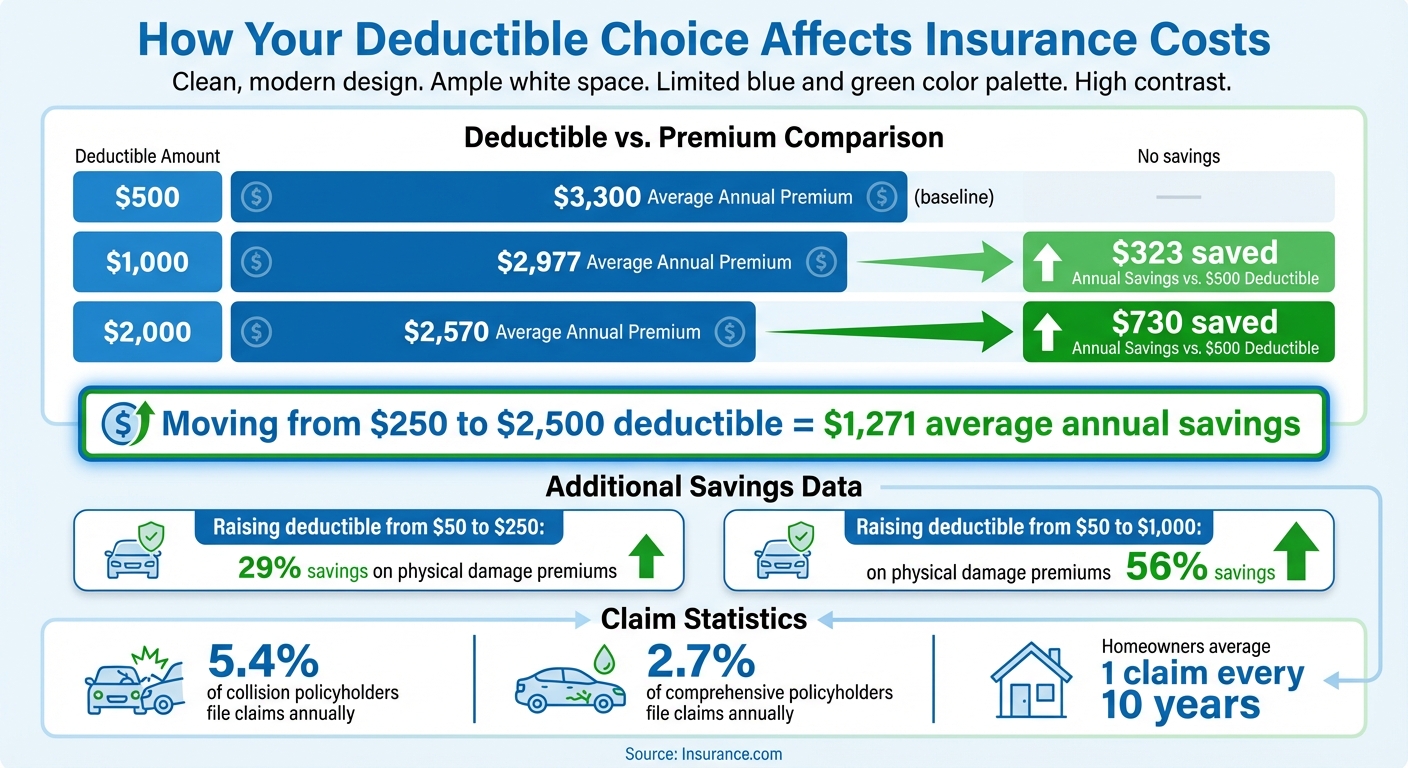
How Insurance Deductibles Affect Your Annual Premiums and Savings
What Is a Deductible?
A deductible is the amount you pay out of pocket before your insurance kicks in to cover the remaining costs of an insured loss. This applies to coverages like collision and comprehensive in auto insurance but doesn’t apply to liability coverage, which covers damage you cause to others.
In homeowners insurance, deductibles can be set as either a fixed dollar amount or a percentage of your home’s insured value. For example, a $1,000 fixed deductible would mean you pay the first $1,000 of any claim. On the other hand, a percentage-based deductible, like 2%, would mean you cover $4,000 for a $200,000 home. In areas prone to natural disasters, percentage-based deductibles are common. For instance, earthquake insurance in states like Washington or Nevada often starts with a deductible of 10% of the home’s replacement value.
Understanding how deductibles work is key to seeing their impact on your premiums.
Lower Deductibles Mean Higher Premiums
When you choose a lower deductible, your insurance company takes on more financial risk, which translates to higher premiums for you. According to Insurance.com, a $250 deductible results in an average annual premium of $3,713, compared to $3,300 for a $500 deductible.
Lower deductibles also make it more tempting to file minor claims. Mark Tucker, an Allstate Insurance Agent, explains:
"It’s how risk is shared between you and your insurer".
However, filing frequent small claims can increase administrative costs and may lead to premium hikes down the line. On the flip side, opting for a higher deductible shifts more of the financial responsibility to you, which can lower your premiums.
How Higher Deductibles Reduce Premium Costs
Increasing your deductible is one of the easiest ways to save on premiums. By taking on more of the initial financial risk, you can see immediate reductions in your insurance costs. For example, raising your deductible from $50 to $250 can save about 29% annually on physical damage premiums. If you raise it further to $1,000, you could save around 56% annually.
Here’s a breakdown of how premiums change with different deductible levels:
| Deductible Amount | Average Annual Premium | Savings Compared to a $500 Deductible |
|---|---|---|
| $500 | $3,300 | – |
| $1,000 | $2,977 | $323 |
| $2,000 | $2,570 | $730 |
Source: Insurance.com
For even larger savings, moving from a $250 deductible to $2,500 could save you an average of $1,271 annually. These savings can add up over time, especially since only a small percentage of policyholders actually file claims each year – about 5.4% for collision coverage and 2.7% for comprehensive coverage. A higher deductible not only lowers your premiums but also discourages filing smaller claims, helping you avoid out-of-pocket costs and potential premium increases for years to come.
Drawbacks of High Deductibles
Out-of-Pocket Costs When You File a Claim
Choosing a higher deductible might save you money on premiums, but it also means you’ll need to cover more out-of-pocket costs when something goes wrong. If you don’t have enough in your emergency fund to cover the deductible, it could leave you in a tough financial spot during an emergency.
This is particularly challenging for homeowners in areas prone to natural disasters. Percentage-based deductibles for events like wind, hail, or hurricanes can lead to hefty expenses. For instance, a 2% deductible on a $300,000 home means you’d need to pay $6,000 before your insurance steps in. In regions like the Midwest or Tornado Alley, wind and hail deductibles typically range between 1% and 5% of your home’s value. Earthquake insurance deductibles can be even higher, ranging from 5% to 25% of the home’s replacement cost.
If you’re unable to cover your deductible when disaster strikes, you might have to delay critical repairs. This can be especially problematic if, for example, your car becomes unsafe to drive and essential for your daily routine. On top of that, deductibles apply to each claim separately, so multiple incidents in a single year can significantly increase your out-of-pocket expenses. These factors can sometimes make filing a claim feel more like a financial burden than a relief.
When Filing a Claim Costs More Than It’s Worth
The financial downside of filing a claim doesn’t stop at the deductible. If the cost of repairs is below your deductible, your insurance won’t cover anything. Even if the damage is just slightly above the deductible, filing a claim might not be worth it.
Karen Axelton from Experian explains:
"Filing claims can cause insurers to raise your premiums, potentially wiping out any savings from the lower deductible".
Additionally, filing a claim could mean losing claim-free discounts and facing premium surcharges for years to come. These long-term costs might outweigh the benefits of filing a claim, especially for minor damages.
How to Choose the Right Deductible
Evaluate Your Emergency Savings and Risk Comfort
Once you understand how deductibles affect your premiums, it’s time to assess your ability to handle out-of-pocket expenses. Only choose a deductible that you can pay immediately if needed. For instance, opting for a $1,000 deductible without sufficient emergency savings could leave you in a tough spot financially.
The value of your vehicle is also a key factor. A $1,000 deductible on a car worth $3,000 means you’d need to cover nearly a third of its value before your insurance kicks in. If you’re financing your vehicle or home, consult your lender first – most require deductibles to stay within $500 or $1,000 . Ultimately, your deductible should align with both your financial readiness and your comfort level with risk. As Licensed Insurance Agent Elin Nozewski from Jerry explains:
"If you can afford a higher out-of-pocket cost in the event of a claim and want to lower your premium, a higher deductible might be suitable".
Compare Premium Savings to Claim Likelihood
To determine if a higher deductible is worth it, calculate the break-even point. For example, if raising your deductible from $500 to $1,000 saves you $323 annually, divide the $500 increase by the $323 savings. The result – 1.5 years – indicates how long you’d need to go without filing a claim to break even. Beyond that, the savings are yours.
The odds may already be in your favor. Only 5.4% of collision policyholders and 2.7% of comprehensive policyholders file claims annually. For homeowners, the average is just one claim every 10 years. If you’ve been claim-free for several years, multiply that time by your potential yearly savings. If the total surpasses the deductible increase, a higher deductible could be the smarter choice.
When adjusting deductibles, consider prioritizing your collision deductible. Collision coverage tends to cost 3 to 5 times more than comprehensive, so raising that deductible often yields greater premium savings. In 2021, the average collision claim was $5,010, compared to $2,042 for comprehensive claims. This makes it a logical area to focus on when fine-tuning your deductible strategy.
These calculations can help you choose a deductible that aligns with your financial situation and risk tolerance.
Deductible Recommendations for Different Situations
Based on the analysis above, your ideal deductible depends on your financial situation and driving habits.
- Tight budgets and families: Stick to $250 to $500 deductibles. While you’ll pay more in monthly premiums, this choice minimizes financial strain in case of an accident. Predictable costs can be a lifesaver when every dollar counts.
- High-risk drivers: If you have recent tickets or accidents, higher deductibles can help offset your higher premiums. Rajni Kapur, President of All Solutions Insurance, advises:
"Carrying a higher deductible is always a strong practice as it makes you more responsible and discourages you from filing small claims. Filing small claims could be counterproductive, eventually leading to higher premiums".
- Safe drivers with solid emergency funds: A deductible of $1,000 to $2,500 could provide the best savings. For Colorado residents, these higher deductibles are particularly beneficial. Military families at Fort Carson and UCCS students with reliable vehicles and good driving records can maximize long-term savings while maintaining adequate coverage.
The Insurance Stops: Colorado Insurance Guidance

Custom Insurance Advice
With 88 years of experience in Colorado Springs, The Insurance Stops is well-equipped to guide you through deductible decisions. If you’re facing SR-22 requirements after a DUI, their same-day filing service can help you stay compliant while managing costs. Their agents understand the challenges of high-risk insurance, where premiums can climb to $100 or more per month. They’ll show you how adjusting your collision deductible could help balance these expenses without leaving you financially vulnerable.
For military families stationed at Fort Carson or students at UCCS, The Insurance Stops offers consultations tailored to your unique needs. They’ll take into account factors like your emergency savings, vehicle value, and driving history. Whether you’re considering a $500 or $1,000 deductible, their agents will help you calculate which option works best for your budget. With access to multiple carriers across Colorado, Idaho, Nebraska, New Mexico, and Texas, they’ll compare policies to find the most affordable and effective coverage for you.
These individualized strategies are designed to align with Colorado’s specific insurance requirements, ensuring your coverage not only fits your budget but also meets state regulations.
Colorado Insurance Knowledge
Colorado’s unique insurance laws play a key role in shaping deductible choices, and The Insurance Stops agents are well-versed in these details. For instance, Colorado law requires insurers to offer collision coverage with deductibles as low as $100 or $250, though many residents opt for higher deductibles to reduce their premiums. Additionally, the state mandates minimum liability limits of $25,000 per person for bodily injury, $50,000 per accident, and $15,000 for property damage.
With an estimated 15-20% of Colorado drivers uninsured, the agency stresses the importance of Uninsured/Underinsured Motorist (UM/UIM) coverage. They’ll explain how Colorado policies automatically include $5,000 in Medical Payments coverage and UM/UIM protection unless you decline them in writing. This knowledge helps ensure that your deductible choice isn’t made in isolation but as part of a broader, well-rounded coverage plan.
Conclusion
Selecting the right deductible comes down to balancing your monthly budget with your ability to handle unexpected costs. For instance, if you have an emergency fund with at least $1,000 set aside, opting for a higher deductible could help you save hundreds annually on premiums. However, if paying $500 out of pocket would put a strain on your finances, a lower deductible with slightly higher monthly payments might be the safer choice.
This decision varies for every individual. As Mark Fitzpatrick, Senior Insurance Analyst at ValuePenguin, explains: "Choosing your deductible is about balancing your budget and the amount of risk you can tolerate". Factors like your vehicle’s value, driving history, and available savings all play a role in determining the best option.
For residents of Colorado Springs, The Insurance Stops has been a trusted resource since 1937, offering guidance on these important decisions. Whether you’re dealing with high-risk insurance after a DUI, need same-day SR-22 filing, or want help comparing deductible options, their agents evaluate your unique circumstances – including emergency savings and state requirements – to find the coverage that fits your needs.
FAQs
How do I choose the right deductible for my insurance?
Choosing the right deductible boils down to your budget, how much risk you’re comfortable with, and how often you think you’ll need to file a claim. Opting for a higher deductible – say $1,000 – can shrink your monthly premiums, but it also means you’ll have to pay more out-of-pocket if you ever need to make a claim. On the flip side, a lower deductible, like $250, will bump up your premiums but ease the financial strain after an accident.
Think about a few key factors: Can you afford to pay the deductible if you have to file a claim? What’s the value of the asset you’re insuring? And how often do you expect to need coverage? For instance, if accidents are rare for you, a higher deductible could lead to long-term savings. If you’re feeling unsure, a trusted local broker, such as The Insurance Stops, can guide you through your options and help you find a plan that matches your needs and budget.
What should I consider before choosing a high deductible?
Choosing a higher deductible can reduce your monthly insurance premiums, but it also means you’ll be responsible for more out-of-pocket costs if you need to file a claim. This trade-off can become a financial challenge if an unexpected event arises and you’re not ready to handle the upfront expense.
When deciding on the right deductible, consider both your budget and your comfort with financial risk. If you have enough savings set aside to cover a higher deductible in an emergency, opting for this route could help you save on premiums. On the other hand, if managing a large, unexpected expense would be tough, sticking with a lower deductible might be the safer route – even if it means paying a bit more each month.
How does raising my deductible affect my insurance savings?
Raising your deductible is one way to trim down your insurance premiums, but it’s a decision that requires careful consideration. For instance, bumping your deductible from $500 to $1,000 might shave off about 8-10% from your premium. Taking it a step further, increasing it to $2,000 could save you roughly 15%. Let’s say your annual premium is $1,200 – this translates to savings of $100 to $180 per year.
Before making the leap, think about how much you’d be comfortable paying out-of-pocket if you need to file a claim. If you’re unsure about the right balance for your situation, The Insurance Stops can provide personalized guidance based on your policy and driving history. Their experts are there to help you weigh your options and find the sweet spot between lower premiums and manageable deductibles.


